AI — Graffiti, London
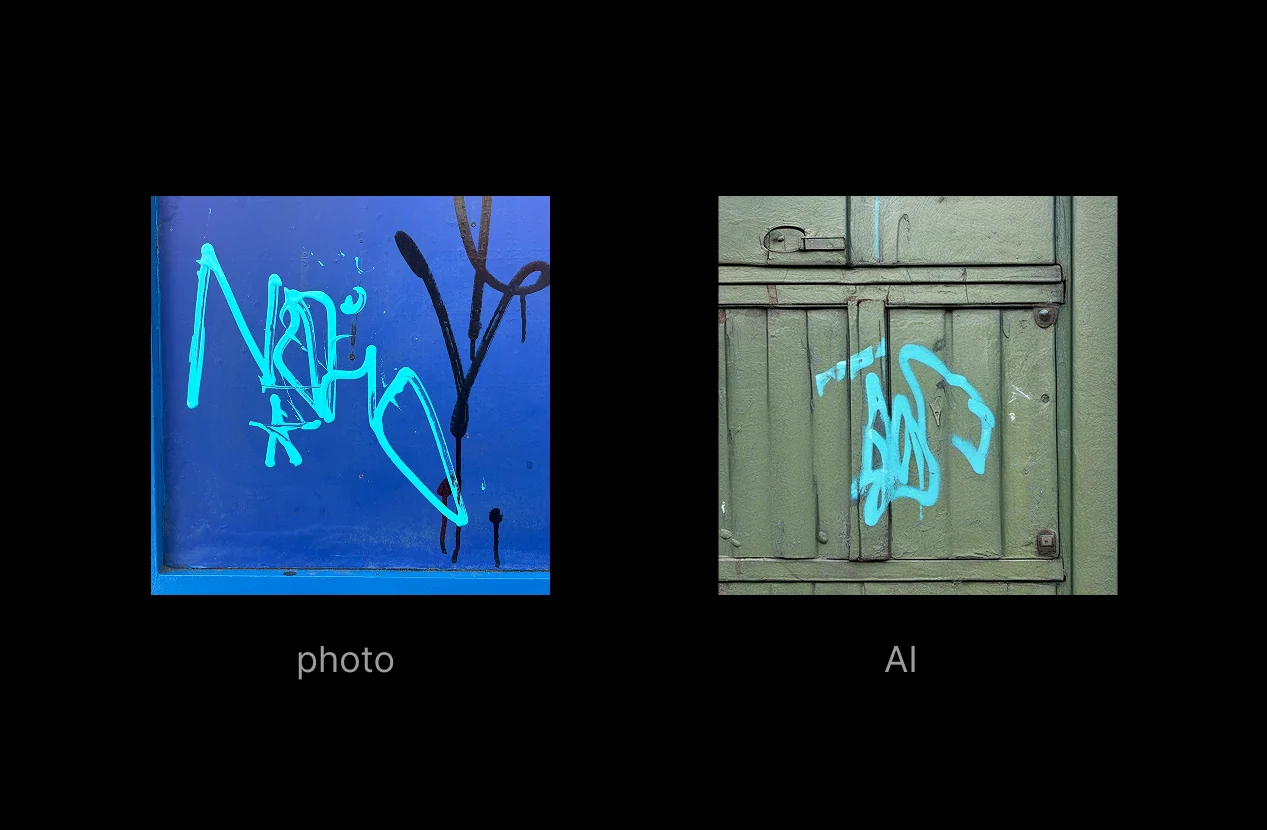
A creative machine learning research project exploring anonymous writing on overlooked urban surfaces in London through photography and LoRA fine-tuning.
- Year
- 2026
- Medium
- AI-assisted Documentation
- Role
- Visual Research
- Tools / Materials
- AI Tools, Photography
Anonymous writing of marginal spaces by ML🤖
This project started from something I noticed in a library bathroom. 🚻🚽 The inside of the toilet door was covered with different kinds of writing and marks. Some were funny and absurd, some felt sad or encouraging, and some were just random drawings or meaningless words. I became interested in how much emotion, humour, loneliness, and small personal stories could appear on such an ordinary and overlooked surface.
Later, I found the term latrinalia, which refers to inscriptions, drawings, and writings carved, scratched, or written on the walls and surfaces of public toilets. This made me think about toilet doors not simply as dirty or vandalised surfaces, but as a kind of anonymous public archive. They are private and public at the same time: people write things there that they may not say elsewhere.
At first, I wanted to focus only on toilet doors and make a machine learning project based on their graffiti. I was especially interested in collecting the dataset myself, and I even imagined visiting many different toilets across London to photograph their doors. However, because of the short project timeframe, it was difficult to collect enough toilet-door images with visible writing. So I expanded the project to include other kinds of anonymous writing in marginal urban spaces, such as graffiti, stickers, scratched marks, bins, walls, underpasses, street corners, and other overlooked surfaces.
For the machine learning process, I chose to use LoRA fine-tuning instead of only generating images from prompts. This allowed me to train the model on around 250 photographs I collected myself. Compared with a general prompt like “graffiti”, LoRA made it possible for the model to learn the specific visual patterns of my dataset: the surfaces, textures, marks, colours, and compositions that appeared repeatedly in the images.
The project is not only about generating graffiti-like images. What I am really interested in is the relationship between anonymous writing and the marginal spaces where it appears. These marks feel almost parasitic: they attach themselves to walls, doors, bins, and corners, but they also reveal something emotional or social about those spaces.
The main question of the project is:
🧐❓“Can a generative model learn and present the emotional and parasitic relationship between anonymous writing and the marginal urban surfaces it inhabits?”
Fieldwork & dataset
LoRA workflow
Image studies
Related project